

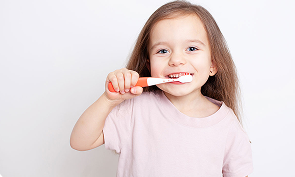
Important Ages to Know in Pediatric Dental Development

Did you know that your little one’s first trip to the dentist should be around their first birthday?
This isn’t just a random milestone – it’s actually recommended by the American Academy of Pediatric Dentistry. This early start lets you tackle any potential issues and set up healthy habits for your child before they can do it themselves.
Here’s everything you need to know about your baby’s first dental visit and other milestones to be aware of along the course of pediatric dental development.
From the average age to lose a first tooth to the average age for a first cavity and more, we’ve got you covered when it comes to knowing about all the important pediatric dental development ages and firsts.
The Early Years: Checkups & Habit-Building
Baby’s First Dental Visit
Ensuring optimal dental health is something that all of us must learn to do over time. The health of the mouth is linked to the health of the rest of the body. So starting your baby off in life with quality dental care is important. Not only does getting your baby to the dentist by age 1 ensure a solid foundation, but it also lets you tackle specific issues such as:
- Handling oral habits like finger-sucking and thumb-sucking.
- Controlling the teething process.
- Evaluating the health of initial teeth.
- Examining the relationship between diet and oral health so you can provide the best diet to your little one from the start.
- Examining the growth of the gums and jawline.
- Learning the basics of caring for an infant’s or toddler’s dental health.
Here’s more information on what to expect during a first visit to the dentist.
Did you know?: With the 2010 passage of the Affordable Care Act, pediatric dental care became an essential health benefit offered to anyone under age 19.
When Do Baby’s Teeth Start Coming In? (Teething Time)
The first baby teeth to come in are usually the lower central incisors, which come in, or “erupt” at around 6-10 months old for most babies. Eruption of baby teeth continues to about 33 months of age with the upper second molars.
This entire period of time from about 6 months to about 2 and three quarters is what’s commonly referred to as the period of “teething”.
When Should Kids Go to the Dentist?
We’ve established that babies should see the dentist for the first time at around 6 months of age. But what about after that?
There are two other important milestones for dental appointments that you should be aware of after that: 4 years old and 7 years old.
Age 2-5 & Cavities
One in four children from ages 2-5 will develop cavities, so watching out for signs of cavities such as discoloration or white spots, pain from a toothache, or visible holes is important. If you think your little one has cavities, you should schedule a pediatric dental appointment ASAP.
Age 4
Assuming you regularly brush your baby’s teeth and gums, even as a newborn, and assuming they don’t have any cavities or other issues, your next routine pediatric dental visit likely won’t need to be until age 4.
Not only is this when your kid’s personality is really starting to shine through, but it’s also a prime time to ditch any lingering habits like thumb-sucking or finger-chewing while ensuring that dental development is occurring normally.
Age 7
At age 7, it’s time to check if your kid needs braces. By this time, their first molars should have erupted, producing a backbite that lets dentists evaluate the front-to-back and side-to-side relationships between teeth.
Depending on what the dentist sees, your child may be okay without braces, or they might refer you to an orthodontist to determine if braces are required.
Keep in mind that your child isn’t likely to get braces until at least age 9 or up to age 14.

Average Age for a First Cavity: Prevention Tips for Tiny Teeth
While there’s no real average age for a first cavity, over half of kids from ages 6 to 8 have had a cavity in their baby teeth pop up during those 2 years, according to the CDC.
Keep in mind that some factors that may contribute to cavities are preventable, such as:
- Consuming too many sugars and starches that lead to mouth pH changes and excess bad bacteria that cause tooth decay.
- Poor oral care routines.
- Using inferior oral care products.
Dealing with a little one with a cavity? Sometimes they happen, despite our best efforts!
Check out our blog post “Preparing Your Child for A Cavity Filling: What to Expect With First Cavity” for more helpful tips and information. Be sure to schedule a dental appointment shortly afterward.
Continued Growth, Care, & Prevention
Average Age to Lose Your First Tooth
We hope that with proper care, you and your little ones never lose your adult teeth! However, “the average adult between the ages of 20 and 64 has three or more decayed or missing teeth”, according to the ADA.
It’s both normal and expected to lose, or “shed” baby teeth as adult teeth grow in. In fact, most kids lose their first baby tooth by age 6 or 7, starting with the upper and lower central incisors. It’s normal for them to keep losing baby teeth through around age 12, with the upper and lower second molars.
From Baby Teeth to Adult Smiles: Milestones in Dental Development
Kids normally get braces put on anytime from age 9-14. But it’s also possible to have braces put on before age 9 in some cases. What’s more, there’s really no age limit to having them put on if you’d like to correct issues in your mouth or create a straighter smile.
Fast-forwarding into adulthood, dental development stops when a person has 32 permanent teeth. This normally occurs after the wisdom teeth come in, around age 17-21.
This is when it becomes especially important to maintain healthy habits with a focus on preventative care.
As an adult, you should see the dentist any time you are experiencing:
- Tooth pain or sensitivity
- Swollen or bleeding gums
- Persistent bad breath
- Discoloration or spots on teeth
- Loose teeth not related to the natural process of losing baby teeth
It’s also important to see the dentist if you’re experiencing a dental emergency as an adult such as:
- Knocked-out teeth
- Chipped, cracked, or broken teeth
- Broken braces and wires
- Toothaches
Schedule a Pediatric Dental Appointment Today!
Whether your little one is ready for their first dental visit, they’re 17 and their wisdom teeth are coming in, or anywhere in between, we invite you to schedule an appointment with The Super Dentists in San Diego for a fun, welcoming, and educational experience.
We aim to make pediatric dental care something you and your little ones want to come back for time and time again.